How Is Interlocking Installed?
Nobody compliments the gravel. But the gravel is why a driveway is still flat in ten years.
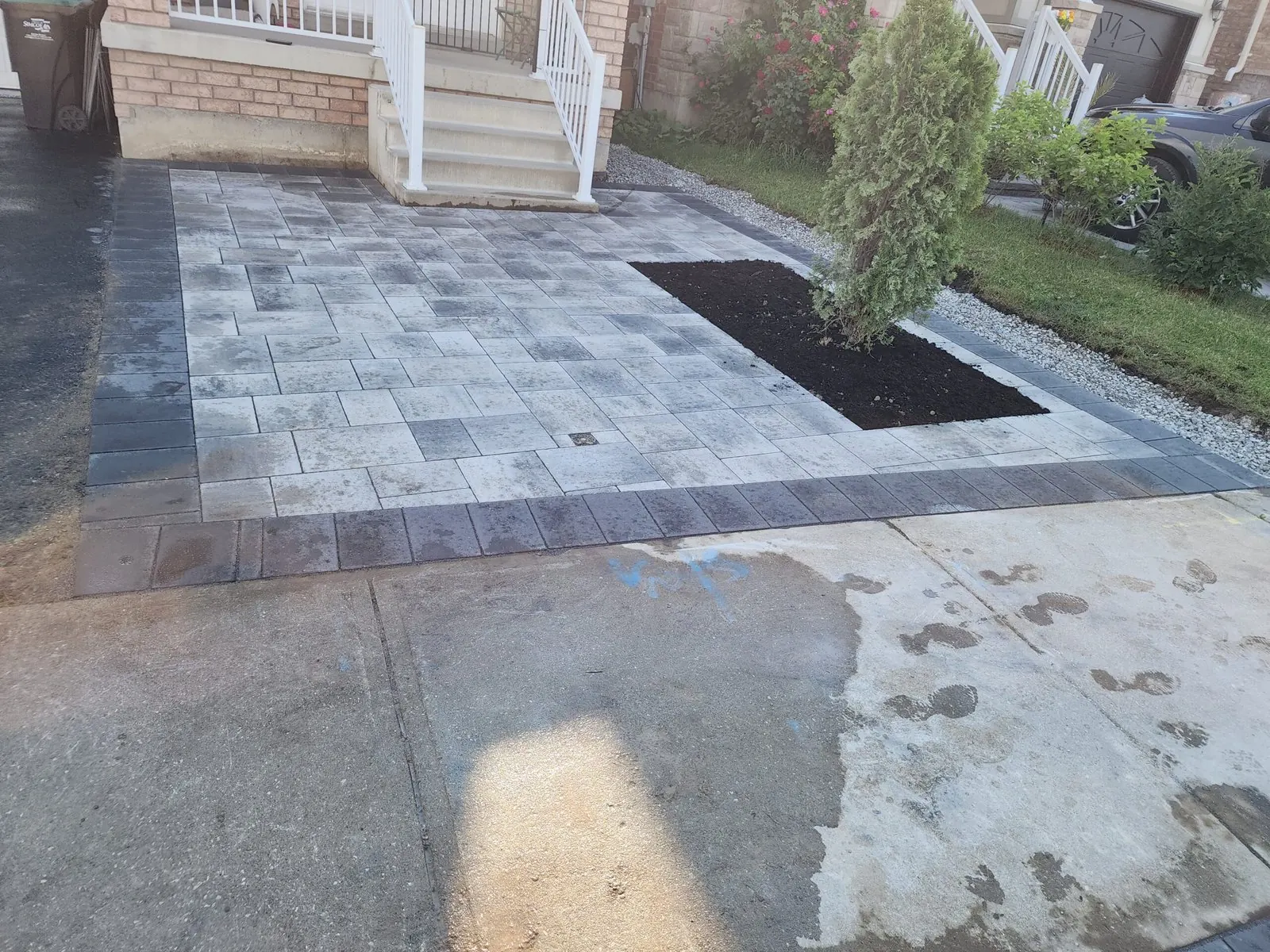
Interlocking is installed in six stages: the area is dug out, a gravel base is built up in layers and compacted, a thin bedding layer is levelled on top, the stones are laid in a pattern, the edges are cut and held with an edge restraint, and the joints are filled with sand and compacted.
Below: each stage in order, what can go wrong at each one, and how to tell a careful job from a rushed one.
What are the steps?
Site visit and layout
We measure, check the slope and find where water goes now. The outline is marked on the ground so you can see the size before digging starts.
Locates
Buried gas, hydro and cable lines are located and marked before any digging. In Ontario that is done through Ontario One Call.
Digging
The old surface and the soil under it come out, to the depth the base needs. A driveway is dug deeper than a path.
Gravel base
Crushed gravel goes in a layer at a time. Each layer is compacted before the next. This is the stage that decides how long the job lasts.
Bedding layer
A thin, even layer is levelled over the base. It is there to seat the stones, not to fix a bad base.
Laying and cutting
Stones are laid in the pattern. Edge stones are cut with a saw to fit curves, borders and walls.
Edge restraint
A restraint is fixed along open edges so the outer stones cannot spread.
Joints and compaction
Jointing sand is swept in and the whole surface is compacted so the stones lock together.
Why is the base the most important part?
Picture a bookshelf on thick carpet. Looks fine. Load it up and it leans.
Stones on a thin or loose base do the same thing. They follow whatever the ground under them does.
In Bradford, the ground moves every winter. Water in the soil freezes and lifts, then thaws and drops. A deep, well-compacted, well-drained base gives the water somewhere to go, so there is less to freeze.
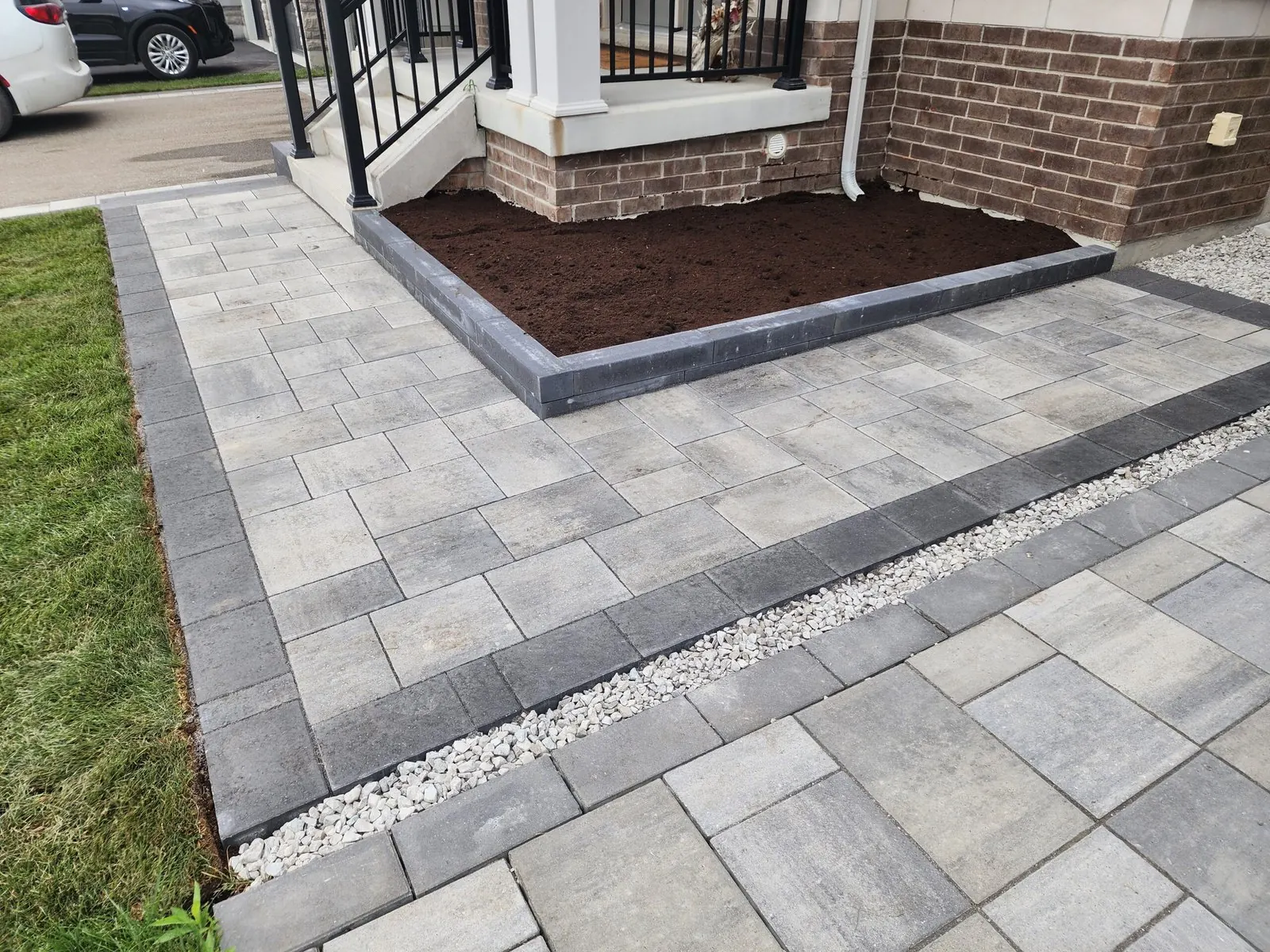
How can you tell a careful job from a rushed one?
You cannot see the base once it is covered. But the surface gives clues.
- Cuts. Edge stones are cut cleanly to a line. No slivers, no gaps filled with sand.
- Lines. Joints run straight and borders stay the same width.
- Slope. After rain, water runs off. It does not sit in birdbaths.
- Edges. The outer stones are held, not just sitting against grass.
- Transitions. Where the stone meets the garage, the steps or the sidewalk, it is flush.
How long does it take?
It depends on the size and the weather. Digging and base work take the most time and cannot be done properly in heavy rain.
We give you a timeline with the estimate. Ready to start? Ask for a free estimate.
Common questions
Can interlocking be laid over old concrete or asphalt?
We do not do it for driveways, patios or walks. The old surface hides the condition of what is under it and traps water. We remove it and build a new base.
What is polymeric sand?
It is jointing sand with a binder that sets when wetted, so it resists washing out. Whether it suits a job depends on the stone and the joint width. We tell you what we are using and why.
Do I need to be home during the work?
Not for all of it. We do need you at the site visit, when the layout is marked, and at the final walk-through. We also need clear access to the driveway and side yard.
What happens to the soil and old asphalt you dig out?
It is loaded and hauled away as part of the job. Removal is included in the estimate so there is no surprise charge for it.
Ready for a price on your job?
We look at the site first, then give you a free estimate.